
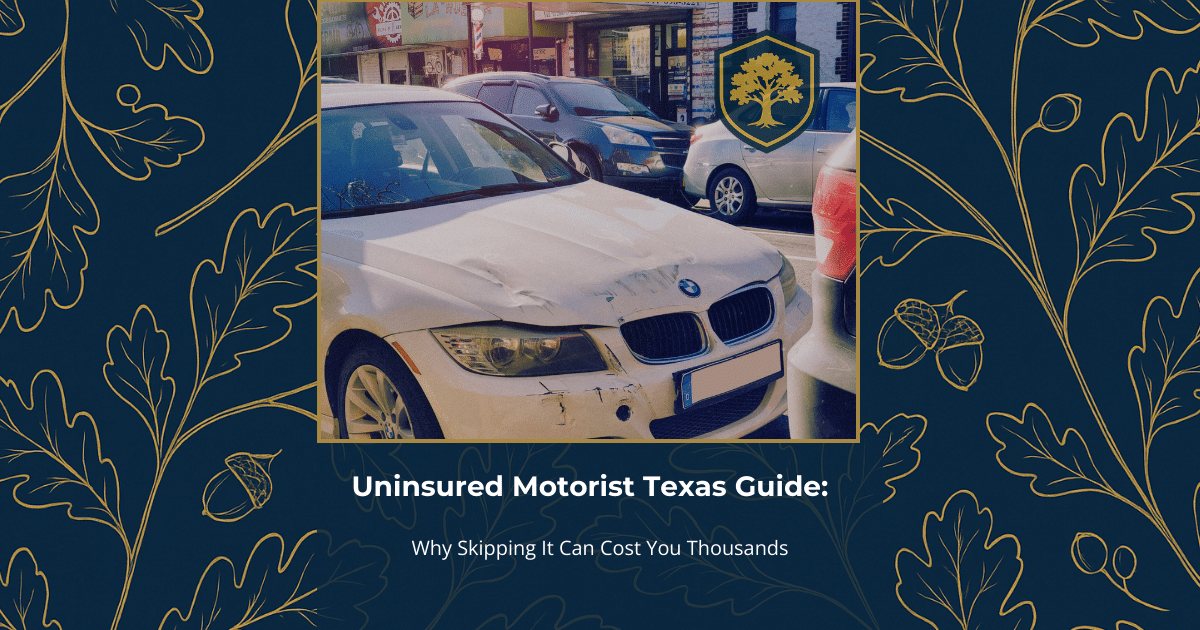
If you drive in Texas, uninsured motorist coverage is one of the most important — and most overlooked — protections on your auto policy. With an estimated 20% of Texas drivers uninsured according to the Texas Department of Motor Vehicles, the odds of being hit by someone with no coverage (or not enough) are higher than most people realize. And when you combine that with the rising cost of medical care and vehicle repairs, skipping UM/UIM can leave your family exposed to financial risk that is completely preventable.
This guide breaks down what uninsured and underinsured motorist (UM/UIM) coverage actually does, why it matters in real Texas scenarios, when it’s smart to keep it, and the limited situations where dropping it might make sense for your household.
What Uninsured Motorist Coverage Actually Is (And Why Texas Drivers Need It)
Uninsured/Underinsured Motorist coverage is broken into two types:
UM/UIM Bodily Injury (UMBI/UIMBI)
Pays for:
- Medical bills
- Lost wages
- Pain and suffering
- Funeral expenses
- Additional damages caused by a hit-and-run driver
UM/UIM Property Damage (UMPD)
Pays for:
- Repairs to your vehicle
- Damage to fencing, mailboxes, or property
- Rental car in some policies
Unlike liability coverage — which protects other people if you cause the accident — UM/UIM protects you if another driver injures you or damages your vehicle and cannot pay.
Texas Liability Gaps Are Bigger Than Most People Realize
Texas requires drivers to carry only:
- $30,000 per person
- $60,000 per accident
- $25,000 for property damage
But this rarely covers:
- Modern vehicle replacement costs
- Advanced medical treatments
- Multi-passenger injuries
- High-end vehicles
- Long-term rehab care
If the other driver hits you and only has minimum limits — or no insurance at all — UM/UIM steps in to pay what they can’t.
The Texas Problem: 20% of Drivers Have No Insurance
According to the TexasSure Insurance Verification system operated by the TxDMV, one in five Texas drivers is uninsured.
Source: Texas Department of Motor Vehicles (TxDMV)
That means:
- At a busy DFW intersection, several vehicles around you may have no insurance.
- Hit-and-run claims are increasingly common in urban areas like Dallas, Austin, and Houston.
- Drivers with “liability only” policies may not have enough coverage to pay for the damage they cause.
When someone with no insurance hits you, you become financially dependent on your own protection. UM/UIM is your safety net.
Why UM/UIM Coverage Is Essential If You Don’t Have Health Insurance
If you lack health insurance, uninsured motorist bodily injury coverage becomes even more important.
Without UMBI/UIMBI, you could face:
- Emergency room bills
- Surgery costs
- Imaging tests (CT, MRI, X-rays)
- Physical therapy
- Follow-up visits
Many Texans don’t realize this:
If you are hit by an uninsured driver and you do not carry UMBI, you may pay the entire medical bill out-of-pocket.
UM/UIM is often the difference between full recovery and long-term financial hardship.
Even If You DO Have Health Insurance — UM/UIM Still Matters
Many Texas drivers decline UM/UIM because they believe their health plan will cover everything.
Here’s the problem:
Health insurance does NOT cover everything an auto accident creates.
UM/UIM provides several protections health insurance does not:
1. Pain and Suffering
Health insurance never pays for non-economic damages.
UM/UIM BI does.
2. Your Passengers May Not Have Health Insurance
If you’re driving:
- Friends
- Extended family
- Co-workers
- Teens or young adults
Their medical bills could become your responsibility under Texas law if you don’t carry enough UM/UIM BI.
3. UM/UIM Helps You Reach Your Health Deductible
This is a huge overlooked benefit.
Your UM/UIM bodily injury coverage can:
- Help meet your deductible
- Help pay your out-of-pocket maximum
- Reduce financial strain on your health plan
This alone makes UM/UIM valuable even with great health insurance.
Uninsured Motorist Property Damage (UMPD): Lower Deductible, Lower Cost
Many Texas drivers don’t realize that UM property damage coverage exists.
Why It Matters:
- Often carries a $250 deductible, much lower than collision.
- Protects your vehicle in a hit-and-run scenario.
- Provides coverage even if you choose liability-only on your auto policy.
UMPD is excellent for:
- Students
- Drivers of older vehicles
- Households trying to keep premiums lower
- Anyone who wants protection from uninsured hit-and-run damage
Collision coverage may cost more and typically requires a higher deductible. UMPD gives Texans a cost-effective alternative.
Hit-and-Run Coverage Texas Drivers Need
In Texas, hit-and-run accidents fall under uninsured motorist coverage, not collision.
You’re protected when:
- A driver hits you and flees
- You’re struck while legally parked
- Someone sideswipes you and drives off
- A driver causes an accident but refuses to exchange information
If the responsible driver cannot be identified, UM/UIM BI and UMPD can cover both injuries and vehicle damage.
When You Should Increase UM/UIM Limits
Most Texans carry:
- $30,000 UM/UIM BI per person
- $60,000 per accident
But medical inflation, rising hospital costs, and modern vehicle repair prices make that insufficient for many households.
Consider higher limits if you:
- Have a family that rides with you often
- Drive frequently on highways or in high-traffic cities
- Do not have great health insurance
- Want protection for lost wages or long-term care
- Want protection from pain and suffering damages
- Drive a newer or more expensive vehicle
In Texas today, the sweet spot for most drivers is:
- $100,000 / $300,000 UM/UIM BI
- $50,000+ UM/UIM PD (or Collision)
This ensures you are fully protected in nearly every scenario.
Common Misconceptions About UM/UIM Coverage
❌ “It’s too expensive.”
UM/UIM is usually one of the lowest-cost coverages on a Texas auto policy.
❌ “I don’t need it — I have health insurance.”
Health insurance doesn’t cover:
- Lost wages
- Pain and suffering
- Deductibles
- Out-of-pocket maximums for passengers
- Vehicle damage in a hit-and-run
❌ “UM/UIM doesn’t cover my car.”
UMPD absolutely does.
❌ “It only applies if the other driver has zero insurance.”
It also applies if they don’t have enough insurance.
Underinsured drivers are just as common as uninsured ones.
Texas Insight
TexasSure data confirms that 1 in 5 drivers on our roads has no active insurance policy. That means every time you drive on I-35, I-20, or Loop 820, you’re surrounded by drivers who cannot pay for your injuries or damage. UM/UIM is your financial backup plan.
Quick Tip
If you are hit and not sure whether to file under:
- Collision
or - Uninsured Motorist Property Damage
start the claim under UMPD first — it may have a much lower deductible than collision. Your adjuster can help finalize the correct path.
Final Thoughts: When UM/UIM Is Essential — and When It Might Be OK to Drop It
Uninsured motorist coverage is one of the most cost-effective protections you can carry in Texas. For a relatively small premium, you shield yourself, your passengers, and your financial well-being from accidents caused by drivers who either have no insurance or not enough to cover the damage. In a state where 20% of drivers are uninsured — and many others carry only minimum limits — UM/UIM is a key part of a complete auto insurance strategy.
That said, there are a few situations where it may be reasonable to decline the coverage:
- You have strong health insurance, and
- Your household members or regular passengers also have reliable health insurance (or you truly never drive with passengers)
- You are not concerned with receiving compensation for pain and suffering, which UM/UIM BI provides but health insurance does not
- You do not want or need Uninsured Motorist Property Damage, which requires UM/UIM BI to be active in order to qualify
If all of these apply, dropping UM/UIM may be acceptable — as long as you understand what you’re giving up.
But for most Texans, UM/UIM remains essential because it provides:
- Protection from high medical deductibles and out-of-pocket maximums
- Coverage for passengers who may not have health insurance
- Compensation for lost wages and pain and suffering
- Lower deductibles for property damage in hit-and-run scenarios
- A safety net when the at-fault driver can’t pay
If you’re unsure whether your current UM/UIM limits fit your needs — or whether dropping it makes sense for your situation — I’m happy to review your policy and help you make a confident, well-informed decision
Contact Me Here.
Custom HTML Follow Block
⚜️ Stay Connected with Gilded Oak
Join us on social for insurance savings tips, light-hearted entertainment, and everyday insights that make coverage easier (and a little more fun) to understand.
Request a QuoteAbout the Author
Luke Faulkner, founder of Gilded Oak Insurance, helps Texas families get clear, confident coverage without the confusion. Luke specializes in breaking down complex insurance topics into simple, practical guidance tailored to Texans. Learn more on our About Page.
Related Articles
- Texas Auto Insurance Guide (2025 Edition)
- Top Car Insurance Discounts Every Texas Driver Should Know
- 7 Smart Reasons to Bundle Auto and Home Insurance in Texas
- Rental Car Coverage Texas: The Essential 2025 Guide
- Full Coverage Car Insurance in Texas: How to Know If You Still Need It
- The Complete Parent’s Guide to Teen Drivers in Texas: GDL Rules, Insurance, and Safe Driving Tips
- Texas Minimum Liability: Understanding 30/60/25 and What Happens When It’s Not Enough
- Texas Hail Damage Auto Insurance: What It Actually Covers
- Comprehensive vs Collision Texas: What Drivers Actually Need (Real Examples + Clear Guide)