

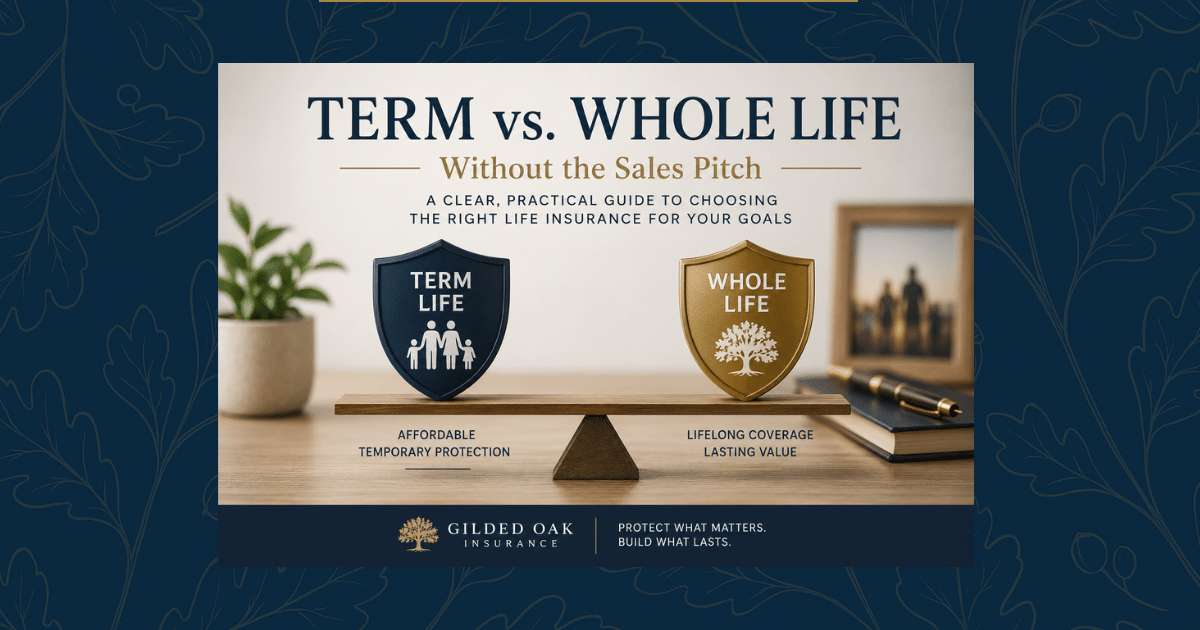
If you’ve spent any time researching Texas life insurance, you’ve probably noticed that conversations around term life vs whole life insurance tend to become surprisingly emotional.
One side says whole life insurance is a waste of money.
The other says term insurance is “renting” coverage and leaves families exposed later in life.
The reality is more nuanced than that.
Term vs. Whole Life Insurance at a Glance
| Term Life | Whole Life | |
|---|---|---|
| Duration | Temporary, fixed term | Lifelong (permanent) |
| Cost | More affordable | More expensive |
| Cash value | None | Builds over time, tax-advantaged |
| Best for | Affordable, temporary protection | Permanent coverage and long-term planning |
| Flexibility | Some policies allow conversion to whole life | Can be combined with term coverage |
For a full picture of your options, see our life insurance coverage overview.
The Core Difference Between Term and Whole Life Insurance
At the simplest level:
- Term life insurance provides coverage for a specific period of time.
- Whole life insurance is designed to provide permanent lifetime coverage while also building cash value over time.
That sounds straightforward, but the implications of those differences are significant.
What Is Term Life Insurance?
Term life insurance is designed to protect against financial loss during your highest-risk financial years.
You select a coverage period, commonly:
- 10 years
- 20 years
- 30 years
If the insured passes away during the term, the policy pays a death benefit to the beneficiaries. If the term expires and the policy is not renewed or converted, coverage ends.
Why Many Families Choose Term Insurance
For many people, term insurance solves the biggest immediate problem:
protecting income and financial stability while raising a family, paying off debt, or building wealth.
Because term insurance focuses purely on protection and does not include permanent cash value accumulation, premiums are generally much lower than whole life insurance for the same death benefit amount.
That affordability allows many families to secure a larger amount of coverage during years when financial responsibilities are highest.
Situations Where Term Insurance Often Makes Sense
Term life insurance is commonly appropriate for:
- Young families with children
- Income replacement planning
- Mortgage protection
- Temporary debt obligations
- Business loans or partnership obligations
- Budget-conscious protection needs
- People still building savings and investments
For example, a couple with young children and a 30-year mortgage may primarily want protection during the years when losing an income would create the greatest financial strain.
In that scenario, term insurance can provide substantial protection at a relatively manageable cost.
What Is Whole Life Insurance?
Whole life insurance is a type of permanent life insurance designed to remain in force for the insured’s lifetime as long as premiums are paid.
Unlike term insurance, whole life policies also accumulate cash value over time on a tax-advantaged basis.
Part of each premium goes toward:
- the insurance cost itself,
- fees and expenses,
- and cash value accumulation inside the policy.
Over time, the cash value may become a financial asset that can potentially be accessed through policy loans or withdrawals depending on the structure of the policy.
Why Some People Choose Whole Life Insurance
Whole life insurance is often less about temporary income replacement and more about:
- permanence,
- long-term planning,
- predictability,
- and financial structure.
Some people value knowing that coverage is designed to remain in place regardless of future health changes or age-related insurability concerns.
Others appreciate the conservative and stable nature of properly structured permanent insurance as part of a broader long-term financial strategy.
Situations Where Whole Life Insurance May Make Sense
Whole life insurance may be appropriate for:
- Estate planning goals
- Lifelong dependents
- High-income earners seeking additional tax-advantaged assets
- Business succession planning
- Legacy planning
- Individuals who value guaranteed permanence
- Families prioritizing long-term stability and predictability
In some cases, whole life insurance can also help people who may later become uninsurable due to health changes maintain lifelong coverage they otherwise could not obtain later.
Why the Debate Gets So Polarized
Part of the confusion comes from the fact that term and whole life insurance are often solving different problems.
Comparing them directly can sometimes be like comparing:
- renting versus owning,
- temporary income protection versus permanent planning,
- or liquidity versus permanence.
Neither is automatically “better” in every situation.
Problems tend to arise when:
- permanent insurance is oversold to people who simply need affordable protection,
- or when term insurance is presented as the only rational option regardless of long-term goals.
Financial planning is rarely that black and white.
The Advantages of Term Life Insurance
Lower Initial Cost
Term insurance is usually the most affordable way to purchase a large death benefit.
Simplicity
The structure is straightforward and easy to understand.
High Coverage Amounts
Because premiums are lower, families can often secure significantly more protection during critical years.
Flexibility
Some people prefer to use the premium savings to:
- invest elsewhere,
- pay down debt,
- build retirement accounts,
- or maintain financial flexibility.
The Potential Drawbacks of Term Life Insurance
Coverage Eventually Ends
If the policy expires before death, no benefit is paid unless coverage is renewed or converted.
Renewals Can Become Expensive
Premiums can increase substantially later in life.
Health Changes Matter
Future insurability is not guaranteed once the original term expires.
The Advantages of Whole Life Insurance
Lifetime Coverage
Coverage is designed to remain in force permanently.
Cash Value Accumulation
Policies build cash value over time on a tax-advantaged basis.
Predictability
Many whole life policies offer guarantees and stable long-term structure.
Potential Estate and Legacy Planning Uses
Permanent insurance can play a role in multigenerational planning or business continuity strategies.
The Potential Drawbacks of Whole Life Insurance
Higher Premiums
Whole life insurance is significantly more expensive than term insurance for the same death benefit amount.
Slower Early Liquidity
Cash value accumulation often builds gradually in the early years.
Complexity
Permanent insurance requires a deeper understanding of policy structure, assumptions, and long-term goals.
Not Always Necessary
Many people simply need affordable protection during their working and family-building years rather than permanent coverage.
A More Practical Way to Think About It
Instead of asking:
“Which policy is better?”
A better question is often:
“What financial problem am I trying to solve?”
For example:
- A young family focused on income replacement may prioritize affordable high-limit protection.
- A business owner concerned about estate liquidity or succession planning may value permanent coverage.
- A high-income professional may eventually want a blend of temporary protection and permanent financial structure.
The right answer depends less on ideology and more on context.
Many People End Up Using Both
One detail often overlooked in online debates is that many financial plans use a combination of term and permanent insurance.
For example:
- permanent insurance may cover lifelong goals,
- while term insurance provides additional temporary protection during higher-liability years.
Insurance planning does not always need to be an either/or decision.
The Importance of Reviewing Policy Structure Carefully
Not all term or whole life policies are designed equally.
Policy performance, guarantees, flexibility, costs, dividend structures, conversion privileges, and long-term sustainability can vary significantly between carriers and policy designs.
That is why thoughtful guidance matters more than slogans or one-size-fits-all opinions.
Final Thoughts
Term and whole life insurance are designed to solve different financial problems. The right choice depends on your goals, responsibilities, timeline, and overall planning philosophy.
For some families, term insurance offers affordable protection during critical working years. For others, permanent life insurance may play a meaningful role in long-term planning and financial stability.
The goal is not to choose sides in a sales debate. It’s to understand the tradeoffs clearly enough to make a thoughtful decision.
Not sure which one fits your situation? I can walk through your goals and help you decide.
Frequently Asked Questions
Is term life insurance better than whole life insurance?
Not necessarily. They are designed for different purposes. Term insurance is often best for affordable temporary protection, while whole life insurance is designed for permanent coverage and long-term planning.
Why is whole life insurance more expensive?
Whole life insurance includes lifelong coverage and cash value accumulation in addition to the death benefit, which increases the overall cost.
Can you convert term life insurance into whole life insurance?
Some term policies include conversion options that allow you to convert to permanent coverage later without additional medical underwriting. Conversion rules and deadlines vary by policy.
Does whole life insurance build cash value?
Yes. Whole life insurance policies build cash value over time on a tax-advantaged basis, although growth rates and accessibility vary by policy structure.
Is it better to buy term and invest the difference?
That depends on financial discipline, long-term goals, risk tolerance, tax considerations, and planning philosophy. For some people, this approach works well. Others value the permanence and structure of whole life insurance.
Can you have both term and whole life insurance?
Yes. Many people combine both types of coverage to balance affordability, temporary protection needs, and long-term planning goals.